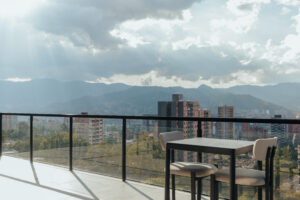
Medellín has spent the last decade near the top of every digital nomad ranking, and the reasons given are always the same: cheap, warm, fast internet, friendly people. All true, and all insufficient. Those four points describe roughly thirty cities.
What actually distinguishes Medellín is more specific, and so are its drawbacks. This guide covers both, written for someone considering a month here rather than a weekend.
Why remote workers keep choosing it
The time zone is the underrated advantage. Colombia runs on UTC-5 year round with no daylight saving changes. That puts you in line with US Eastern time for half the year and one hour behind for the other half. If your clients or team are in North America, you keep a completely normal working day. No 5am calls, no explaining your availability. Nowhere in Europe or Asia offers this.
The climate removes a variable. Between 18°C and 28°C every month. No seasonal affective slump, no heating bills, no packing decisions.
The infrastructure is real. Fibre internet in the main districts handles video calls and large uploads without drama. The metro works. Water is drinkable. Healthcare is genuinely good and inexpensive.
The community already exists. This matters more than it sounds. Arriving somewhere with an established remote-work population means the coworking spaces, the Spanish exchanges, the run clubs and the social infrastructure are already built. You are joining something rather than starting one.
The honest drawbacks
The hills. El Poblado is built on a slope, and photos flatten it. Walking anywhere involves gradient. This is the most common complaint from people who arrive expecting a walkable flat city.
The bubble. It is entirely possible to spend a month in El Poblado speaking only English, eating international food and meeting only other foreigners. Many people do, and then report that Medellín was fine but nothing special. That is a self-inflicted outcome.
Short-stay churn. Building friendships in a city where most people leave after four weeks takes deliberate effort.
Where to live
El Poblado is where most arrivals land. Highest concentration of restaurants, coworking and English speakers. Also the most expensive, the noisiest around Provenza, and the steepest.
El Tesoro sits higher up within El Poblado. Residential, notably quieter, built around a major shopping and services hub. Trades nightlife proximity for calm which after week two is usually the trade people wish they had made. It is where much of the long-stay furnished apartments medellin inventory has concentrated.
Laureles is flatter, more local and less expensive. Grid layout, tree-lined streets, far fewer tourists. Better Spanish practice, slightly less convenience.
Envigado is a separate municipality bordering El Poblado. Quieter and cheaper, with a genuine town centre. Requires more travel time.
Cost expectations
Precise figures date quickly, but the structure holds: housing is by far your largest line, typically more than everything else combined. Food, transport and entertainment are inexpensive relative to North American or European baselines.
Three things newcomers consistently underestimate:
- Ride-hailing frequency. The hills mean you take more cars than you planned.
- Eating out. Cheap per meal, expensive at five times a week.
- Short-stay premiums. Nightly rates are dramatically higher than monthly rates. Committing to a month rather than booking week by week is the single largest saving available.
For that reason most operators offering apartments for rent in medellin colombia work on monthly minimums, and the per-night difference is substantial.
Working here practically
Internet. Fibre in El Poblado, El Tesoro and Laureles supports calls and uploads comfortably. Test the actual speed at your desk during your real meeting hours before committing to a place building-level and unit-level performance vary.
Backup. A local SIM with a data plan as a hotspot fallback costs very little and removes an entire category of anxiety.
Where to work. Coworking spaces sell day, week and monthly passes. Specialty cafes are plentiful but variable on wifi and power outlets. If your accommodation includes workspace, that removes the daily decision entirely.
The part most guides skip
The difference between a good month and a forgettable one in Medellín is almost never logistics. It is whether you build a routine.
People who leave saying the city changed something for them did the same things: they committed to a recurring activity, they learned enough Spanish to have real interactions, they left El Poblado regularly, and they stayed long enough for a week to feel like a week rather than a highlight reel.
People who leave underwhelmed did none of those. They stayed three weeks, worked from a different cafe every day, socialised only with other newly arrived foreigners, and never developed a single repeating commitment.
The city rewards depth over movement. That is the actual advice.
Language
You can survive in El Poblado on English alone. You cannot live well in the wider city without some Spanish. Even a basic level changes the texture of daily interactions noticeably, and Medellín’s accent is among the clearest in Latin America for learners.
A realistic first month
Week one: arrive, sleep, adjust, walk your neighbourhood, do nothing ambitious.
Week two: commit to two recurring activities. A class, a gym, a language exchange. Recurrence is the mechanism.
Week three: leave the city. Guatapé, Jardín, Santa Fe de Antioquia. Perspective helps. Week four: decide whether to extend. Most people do.
Frequently Asked Questions
Why is Medellín popular with digital nomads?
A stable year-round climate, a US-aligned time zone with no daylight saving, reasonable costs, strong infrastructure and an established remote-work community.
How long do most nomads stay?
One to three months is the most common range, which is why monthly-minimum accommodation dominates the long-stay market.
Which neighbourhood should I choose?
El Poblado for convenience, El Tesoro for a quieter residential base, Laureles for a flatter and more local experience at lower cost.
Do I need Spanish?
Not to get by in El Poblado, but even basic Spanish noticeably improves daily life anywhere else in the city.
What is hardest to adjust to?
The hills, rush-hour traffic, and the effort required to build real routine in a city where most foreigners leave after a few weeks.